
Purpose-built succession intelligence
AI that understands the succession process—not just the conversation.
A guided, evidence-aware system that helps professional advisers understand what is known, what is missing and whether a family is ready to move forward.
One sentence · one chain of work
“Sarah will take over the farm.”
- Source
- Preserved as said, and attributed to John.
- Classification
- An assumption. Not Sarah’s confirmed intention.
- Follow-up
- Ask Sarah directly about work, ownership, debt, timing and risk.
- Case effect
- Pathways relying on Sarah stay conditional until she confirms.
The AI recommends. The adviser reviews and confirms.
This is not a chatbot attached to a client file
One sentence. Two completely different outcomes.
General-purpose AI
It can summarise the sentence.
- Receives an individual prompt.
- Produces a summary or some suggested questions.
- Creates another document the adviser has to manage.
Succession Navigator
It understands the effect on the case.
- Preserves the source and separates an assumption from a fact.
- Identifies Sarah as the person who has to be heard directly.
- Creates targeted work and shows what progression depends on it.
- Requires adviser confirmation at material decision points.
Choose what you want to understand
Nine capabilities. Three answers each.
Pick a topic and see what the AI does, what the adviser controls and what the case gains, with a worked example from the demonstration case. The full explanation is there for anyone who wants it.
Selected capability · Evidence and assumptions
A confident statement is not allowed to become an accidental fact.
One sentence in a family meeting can carry a preference, a memory, an old promise or a verified fact.
Treating them alike is how an assumption ends up inside a plan. The platform is designed to keep them apart, with the source attached to each one.
One statement, one chain of work
“Sarah will take over the farm.”
Source
John Murray, Meeting 1. Recorded as his understanding.
Classification
An assumption. Not Sarah’s confirmed intention.
Recorded position
Sarah Nguyen is recorded as an off-farm daughter. Tom Murray is the recorded potential successor.
Follow-up
Ask Sarah directly about work, ownership, debt, timing and risk.
Case effect
Any pathway relying on Sarah stays conditional until her position is confirmed.
The AI recommends. The adviser reviews and confirms.
Three answers, every time
Statements, verified facts, assumptions, preferences and disputed matters stay clearly distinguished.
- The AI does
- Separates statements, verified facts, preferences, intentions, assumptions, disputes and matters awaiting professional validation, and keeps the source with each one.
- The adviser controls
- Whether a classification is right, and whether the supporting evidence is enough for anything to be treated as settled.
- The case gains
- A defensible record of what was said, who said it, what supports it and what still has to be tested.
Facts, assumptions and opinions remain clearly separated
Family succession conversations contain many different kinds of information. One person may be expressing a preference. Another may be recalling an old promise. A parent may be describing what they believe a child wants. A document may establish a verified fact. A professional opinion may still be required before anything can be treated as settled.
Succession Navigator is designed to distinguish between statements, verified facts, preferences, intentions, assumptions, disputed matters, concerns, conditions, decisions, risks, actions and professional validation requirements.
This prevents a confident statement from quietly becoming an accepted fact simply because it appeared in a meeting transcript. It also gives advisers a more defensible record of what was said, who said it, what supports it and what still needs to be tested.
Showing Evidence and assumptions.
The limits, stated
What the software will not do.
These hold regardless of which capability you were reading about.
- AI recommendations remain recommendations.
- The facilitator reviews the evidence and confirms material decisions.
- The software does not determine what is fair.
- Silence, attendance and an absence of objection are not treated as agreement.
- Preliminary legal, taxation, lending, valuation and financial assumptions are not represented as professional advice.
- Pathways remain conditional while they depend on unconfirmed information.
- The adviser controls confidentiality and family-facing information.
- The system maintains sources, evidence history and versions.
- The software strengthens professional judgement. It does not replace it.
How the intelligence works
Every conversation makes the case more useful.
A method, a memory and a professional purpose. Each step happens because the one before it happened.
The family talks
The facilitator leads a natural conversation.
The AI listens for relevant information
It picks up what relates to this stage.
The structured case updates
Information is classified, attributed and linked.
Gaps become targeted work
What is missing becomes questions and assigned work.
The readiness gate assesses progression
The case is measured against what is still unknown.
Can hold the case
The adviser reviews and confirms
The facilitator checks the recommendation and decides.
The case progresses only when ready
The next stage follows the case, not the calendar.
The case progresses because it is ready, not because the meeting ended.
- The family talks. The facilitator runs a natural conversation, supported by preparation notes, meeting context and the existing case record.
- The AI listens for relevant information. It identifies information connected to the current chapter, including statements, intentions, concerns, assumptions, risks and possible decisions.
- The structured case updates. Relevant information is classified, attributed and connected to the correct people, assets, issues and chapter outcomes.
- Gaps become targeted work. The AI recommends follow-up questions based on what has not yet been sufficiently understood. Second-hand statements, missing evidence and professional dependencies become family activities, document requests, referrals or assigned actions.
- The readiness gate assesses progression. The case is measured against what still has to be known, rather than against how many meetings have taken place.
- The adviser reviews and confirms. The facilitator reviews the AI’s recommendation and determines whether the chapter is complete, requires follow-up or remains blocked.
- The case progresses only when ready. The next stage is recommended based on the state of the case, not merely because the meeting ended.
Where general-purpose AI stops
Useful assistance is not the same as a method.
General-purpose AI is genuinely useful assistance, and plenty of advisers already work with it. What it does not bring is the method, the connected case or the controlled progression.
Where it operates
General-purpose AI: An individual prompt
Succession Navigator: A structured succession journey with defined outcomes
What it produces
General-purpose AI: A summary or generated content
Succession Navigator: Classified, attributed and connected case information
What happens next
General-purpose AI: A suggested output
Succession Navigator: Readiness-controlled progression with adviser confirmation
| General-purpose AI assistance | Succession Navigator |
|---|---|
| Responds to an individual prompt | Works within a structured succession journey |
| Produces questions or written content | Connects questions to defined case outcomes |
| Summarises what was said | Classifies, attributes and links information |
| May treat statements similarly | Separates facts, assumptions, preferences and disputes |
| Produces a list of suggested tasks | Creates connected activities with owners, priorities, due points and progression impacts |
| Can draft possible options | Assesses whether the case is ready for option development |
| Generates persuasive prose | Keeps assumptions, dependencies and professional validation visible |
| Leaves review to the user | Requires facilitator confirmation at material decision points |
| Creates another document | Contributes to a living, versioned succession case |
General-purpose AI
Responds to an individual prompt
Succession Navigator
Works within a structured succession journey
General-purpose AI
Produces questions or written content
Succession Navigator
Connects questions to defined case outcomes
General-purpose AI
Summarises what was said
Succession Navigator
Classifies, attributes and links information
General-purpose AI
May treat statements similarly
Succession Navigator
Separates facts, assumptions, preferences and disputes
General-purpose AI
Produces a list of suggested tasks
Succession Navigator
Creates connected activities with owners, priorities, due points and progression impacts
General-purpose AI
Can draft possible options
Succession Navigator
Assesses whether the case is ready for option development
General-purpose AI
Generates persuasive prose
Succession Navigator
Keeps assumptions, dependencies and professional validation visible
General-purpose AI
Leaves review to the user
Succession Navigator
Requires facilitator confirmation at material decision points
General-purpose AI
Creates another document
Succession Navigator
Contributes to a living, versioned succession case
In the product
See exactly what has been established, and what has not.
One conversation, five real screens. Choose a stage to see what it puts into the case.
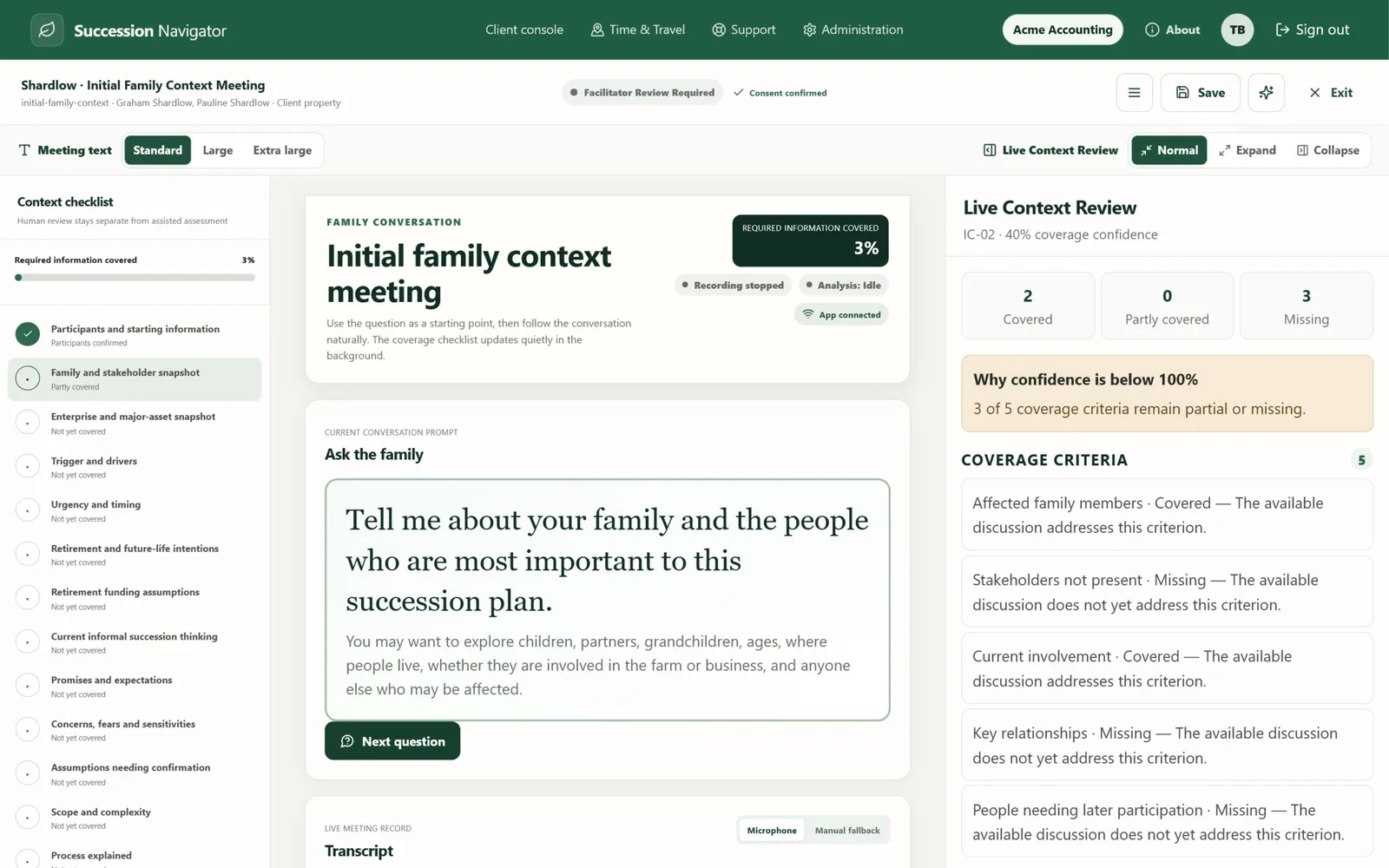
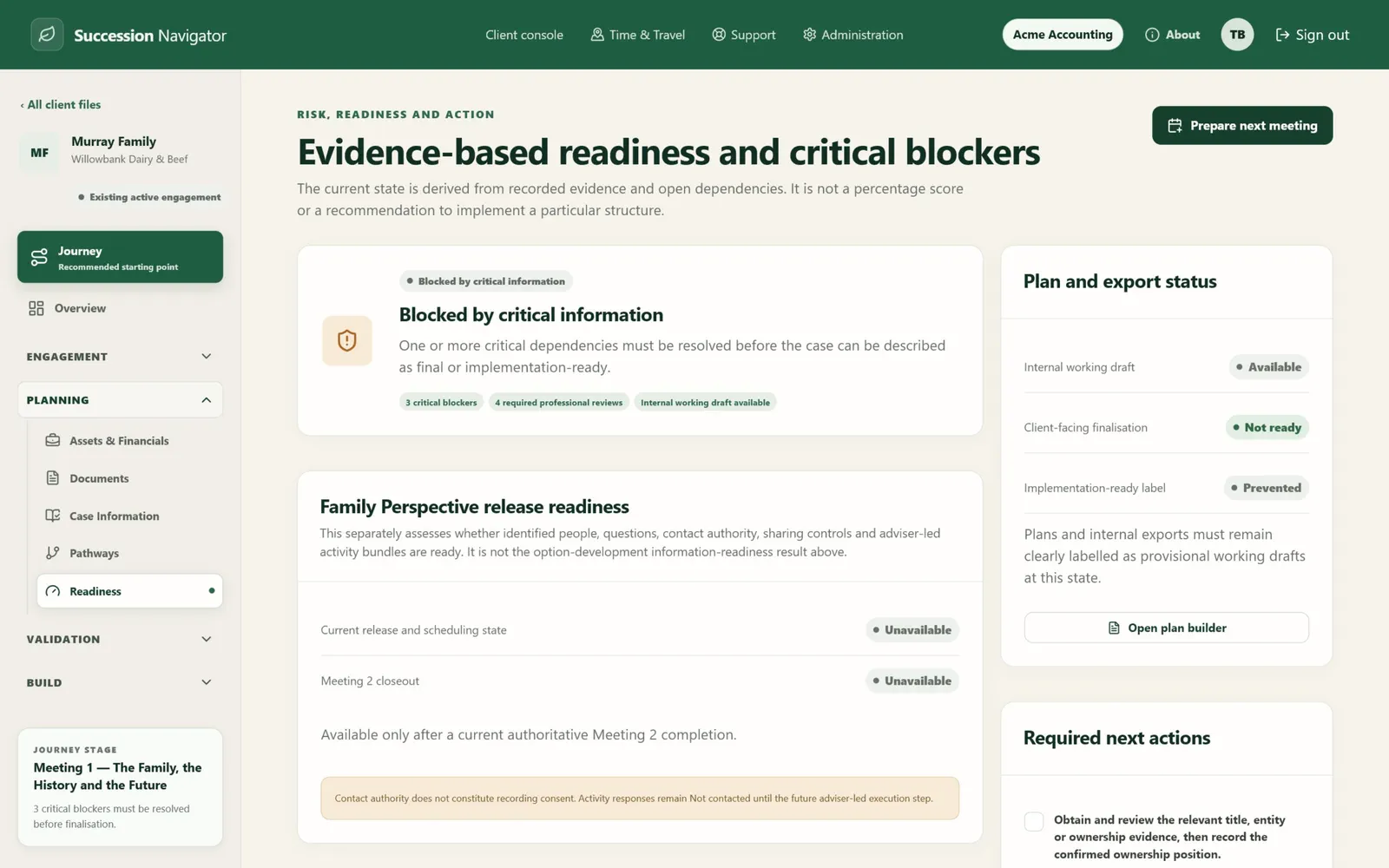
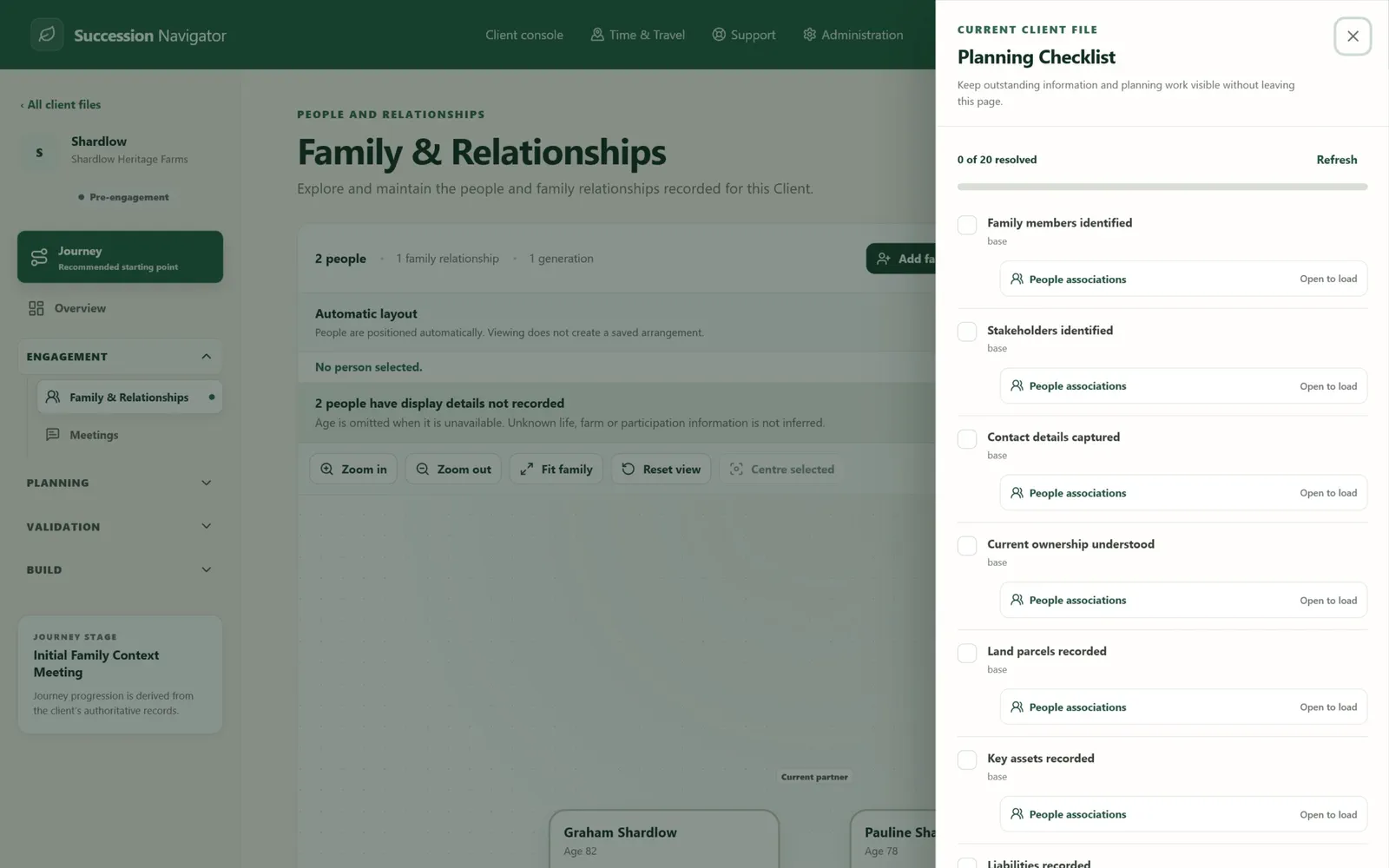
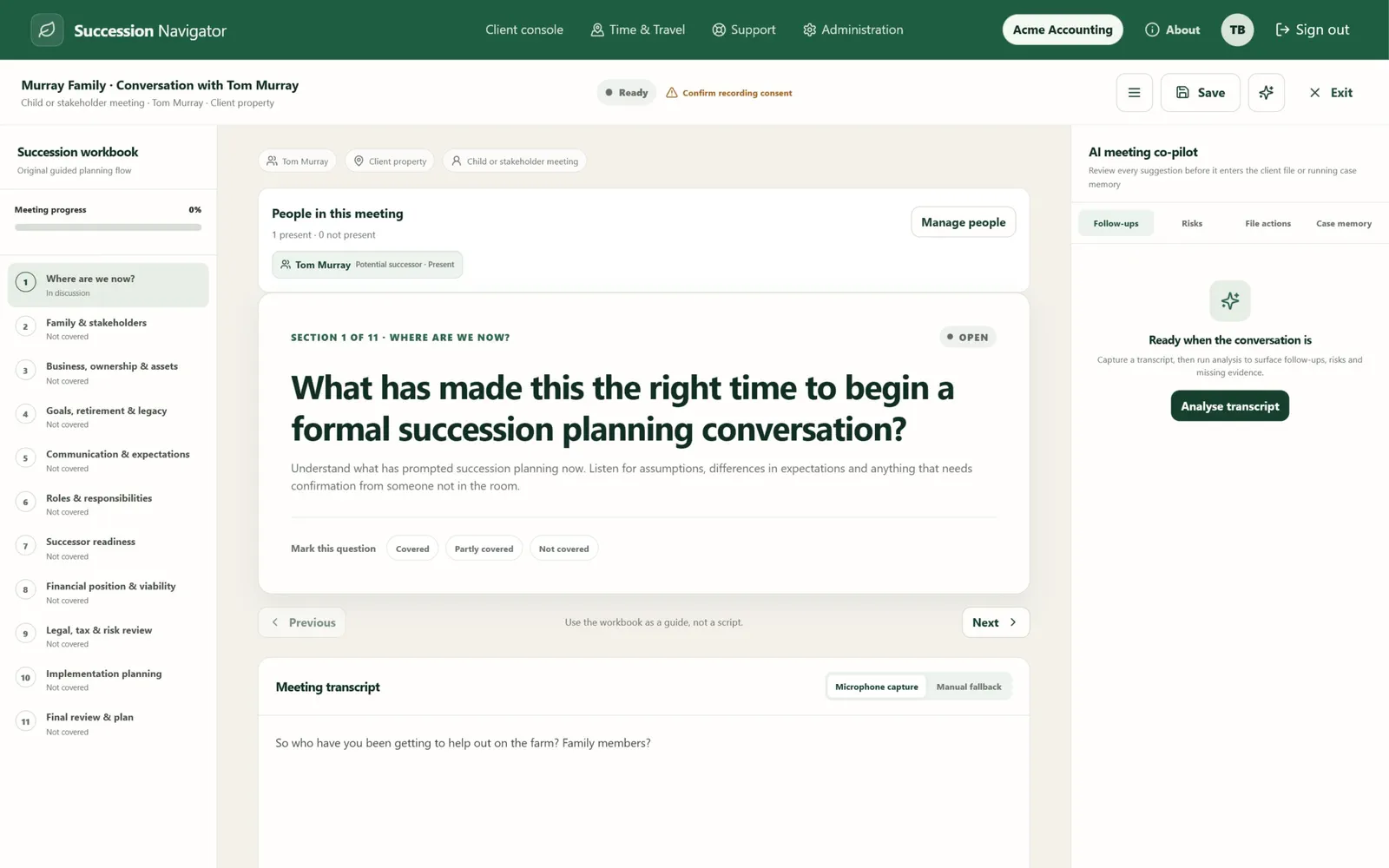
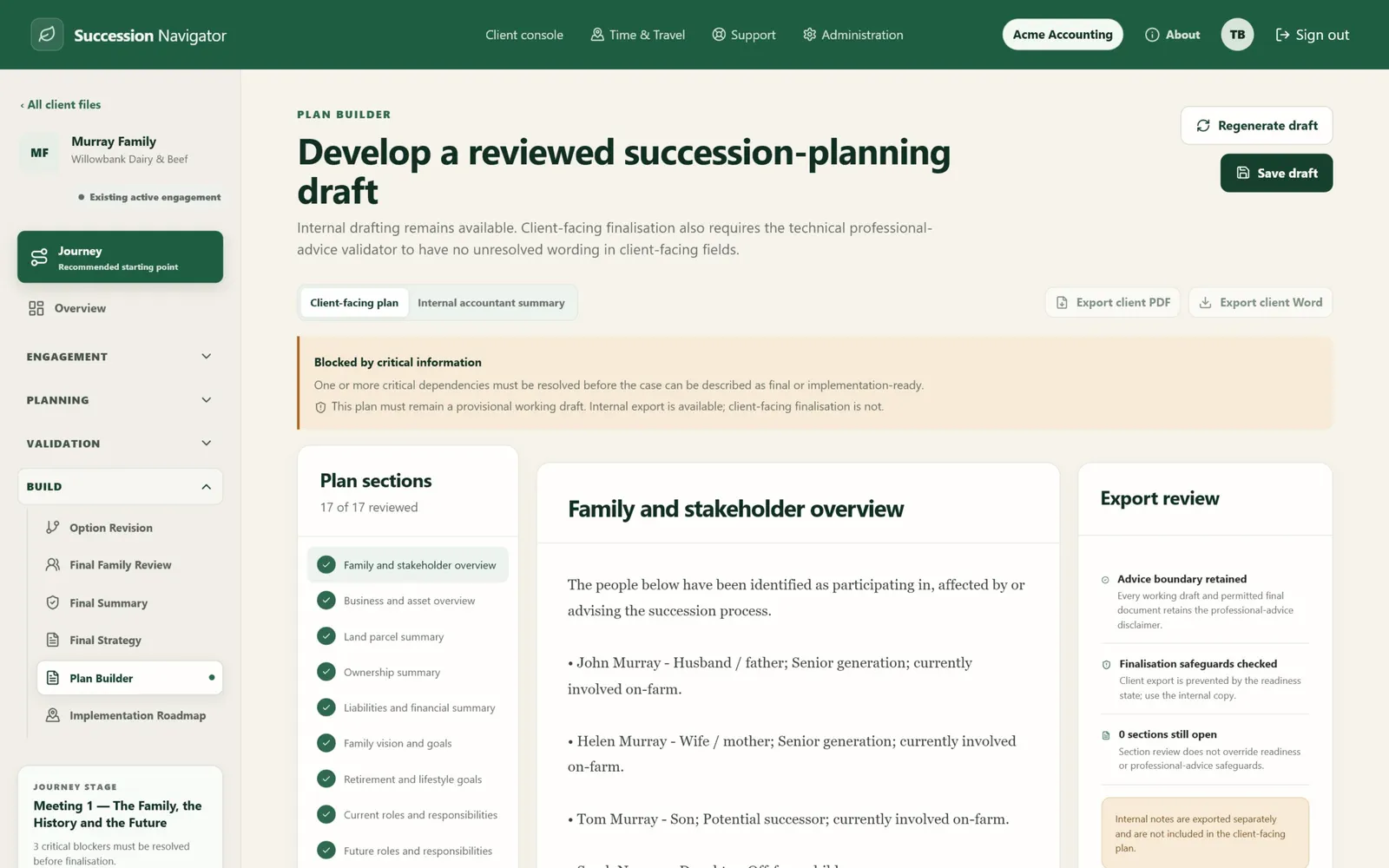
A smarter conversation, without turning the meeting into an interrogation
The facilitator runs the discussion. The platform follows what is being said and suggests where it is worth going next.
What changes in the case
The family is talking, and the case is already being built. Nothing has to be typed up afterwards from memory.
Illustrative example using the built-in Murray family demonstration case. Not a real client.
Showing A meeting in progress.
A complete succession planning capability
Keep the conversation human. Keep the information connected.
Deliver a more consistent succession service without treating every family the same, and retain professional judgement where it belongs: with the adviser.
A conversation about your practice, the opportunity in your farming client base, and whether it's worth taking further. .
What it costs to start
From $150+ GST per month
A complete succession planning capability without the cost of building one yourself.
Practice plans are priced per practice. We confirm the detail for yours at the discovery session rather than leaving you to guess at a range.