
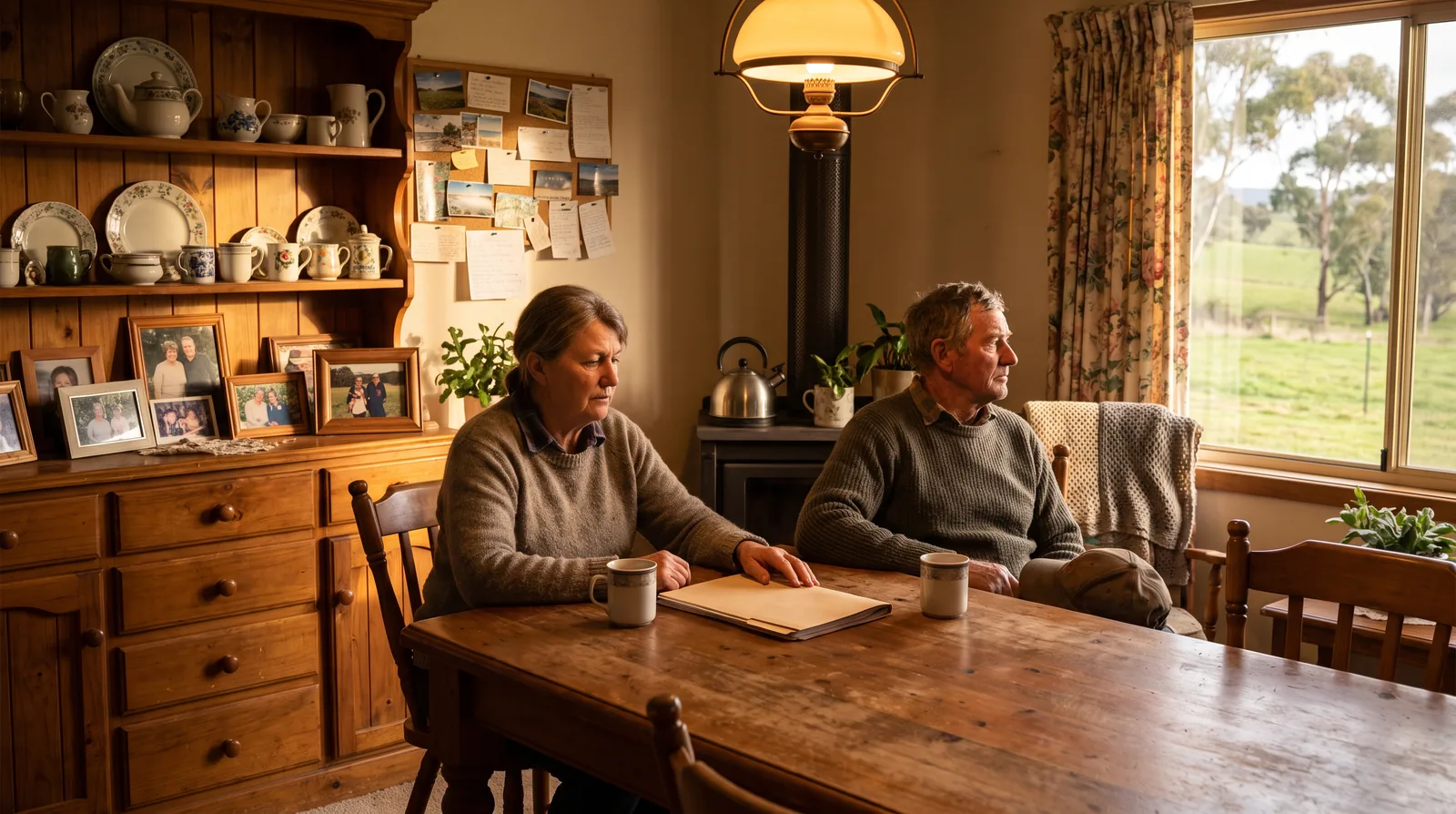
There is a particular sentence heard on farms all over Australia: “We’ll sort the succession stuff out later.” Later might mean after harvest, after the next good season, after the debt comes down, after one of the kids makes up their mind, or after Mum and Dad decide where they want to live. Sometimes “later” quietly becomes ten years.
And sometimes there isn’t a later.
That is the part of succession planning many farming families do not really want to talk about. Not because they do not care about their family, but often because they care deeply and know the conversation could be difficult. Someone might be disappointed, old promises may come back to the surface, and questions about who gets the farm, who has worked hardest and what is actually fair can quickly become emotional.
So it feels easier to leave things alone.
But leaving things alone does not make the problem disappear. It simply transfers the problem to somebody else.
If you go first, who deals with the mess?
Imagine the farmer who has always been the one holding everything together dies unexpectedly. There may be a will, there may have been conversations over the years, and there may even be a general sense within the family about what Dad wanted. But general understandings have a habit of becoming much less clear once the person who created them is no longer there to explain what they meant.
Perhaps Dad told one son, “One day this will all be yours.” Perhaps he said something slightly different to a daughter. Perhaps his wife knows roughly what he wanted but was never really involved in the detail.
Now Dad is gone.
Very often, the person standing in the middle is his wife. At exactly the point when she has lost her husband, she can suddenly find herself dealing with questions she cannot confidently answer. What did Dad promise? Who gets the farm? Is anything meant to be sold? What happens to the child who has worked there for 25 years? What about the children who left? How much debt is there? Can Mum afford to stay?
That is an extraordinary burden to leave someone.
She is grieving, but she may also be expected to become the referee, historian, financial decision-maker and family negotiator. Every decision she makes can feel as though she is taking somebody’s side, particularly if different family members remember past conversations differently.
That is what “we’ll sort it out later” can actually look like.
Your family will remember how you left things
Most people think about succession in terms of assets: the farm, machinery, livestock, houses, superannuation, investments and cash. But there is another inheritance that never appears on a balance sheet.
Relationships.
If succession is badly handled, the consequences can last far longer than the financial settlement itself. Brothers and sisters who once got along can stop speaking, grandchildren can lose contact with cousins, and family gatherings can disappear. Someone who spent much of their working life on the farm may feel betrayed, while an off-farm child may feel they were never properly considered.
A surviving spouse can then spend years trying to keep peace between people they love. The hardest part is that the person everyone is arguing about may no longer be there to explain what they intended.
You may know exactly what you mean today. Your family only has what you leave behind.
Your reputation is part of the inheritance too
Most farmers care deeply about what they leave behind. It is not only the land or the business, but the family name, the relationships with neighbours, the standing they have in the community and the reputation built over decades.
You can spend 50 years building something people respect and still leave behind a situation that causes enormous resentment. That may sound harsh, but it raises an important question: how do you want your children and grandchildren talking about you ten years after you are gone?
Do you want them saying, “Dad thought this through. We didn’t all get everything we wanted, but we understood why he made the decisions he made”?
Or do you want them saying, “Dad knew this was going to be a problem and never dealt with it”?
Those are very different legacies.
Doing nothing is still a decision
Avoiding succession planning can feel neutral, but it is not. Every year circumstances continue to change. Children get older, grandchildren arrive, relationships change, property values move, debt changes and health can alter quickly.
People also make significant decisions about their own lives based on what they believe is going to happen. Someone may remain working on the farm because they believe they have a future there. Someone else may move away because they believe they do not.
The longer assumptions are left unspoken, the harder they can become to untangle.
Succession planning does not mean handing over the farm next Tuesday. It does not mean Mum and Dad have to retire, sell everything or make every decision immediately.
It means starting the conversation while you are still here to have it.
You do not have to work it out alone
One reason families avoid succession planning is because the issues can feel too big to deal with all at once. There may be emotional questions inside the family, but there are also technical questions around debt, ownership, tax, retirement income, estate planning, finance and property transfers.
That is where trusted professional advisers can help.
An accountant, agricultural consultant, solicitor, financial planner or other adviser does not replace the family’s decisions. Their role is to help separate the technical issues from the emotion, test whether proposed outcomes are realistic and identify consequences that may not be obvious at the kitchen table.
A structured succession process can also make the conversation easier. Rather than beginning with “Who gets the farm?”, it can start with understanding the family, the business, the assets, the expectations and what each person is trying to achieve.
That gives everyone something more useful to work from than assumptions and half-remembered conversations.
The first step is simply to start
You do not need to solve everything in one meeting.
A practical first step is to sit down with your partner and begin talking about what you both want the future to look like. From there, involve your advisory team and work through the issues in a structured way.
Clarify what you own. Understand the debt. Talk about retirement. Identify the people who need to be involved. Bring old promises and assumptions into the open. Then work through the legal, financial and practical steps needed to turn intentions into a plan.
Because eventually, one way or another, the farm will pass to someone else.
The choice is whether you help shape that transition while you still can, or leave the people you love to work it out after you are gone.
The farm won’t inherit your intentions. Your family will inherit the consequences.